Per-member privacy boundaries
A family model where each member carries their own visibility rules, enforced server side rather than hidden in the interface.
Capability Demonstration
A self-initiated proof of concept in security-grade product engineering.
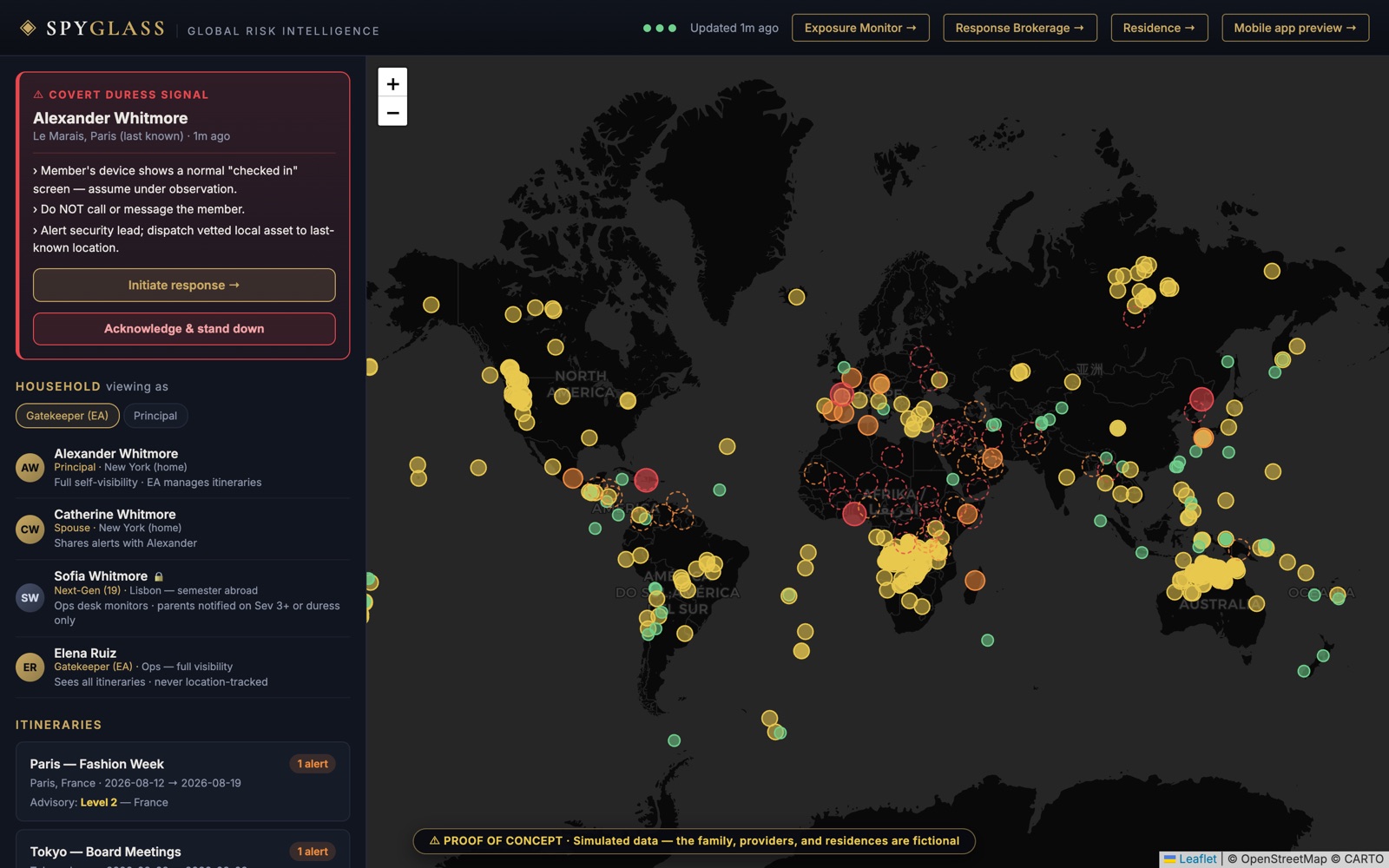
Spyglass is a self-directed Hunt Apex proof of concept. All people, families, providers, and residences shown are fictional; provider names are illustrative and imply no partnership or endorsement. Incident data shown comes from public feeds; the curated intelligence layer is simulated.
Duty-of-care software for travelers is built for corporations tracking employees; the private-client market that protects families is served almost entirely by human services with thin, dated software behind them. We set out to prove a different approach, and to demonstrate, on our own initiative, how Hunt Apex takes a problem from research to running software.
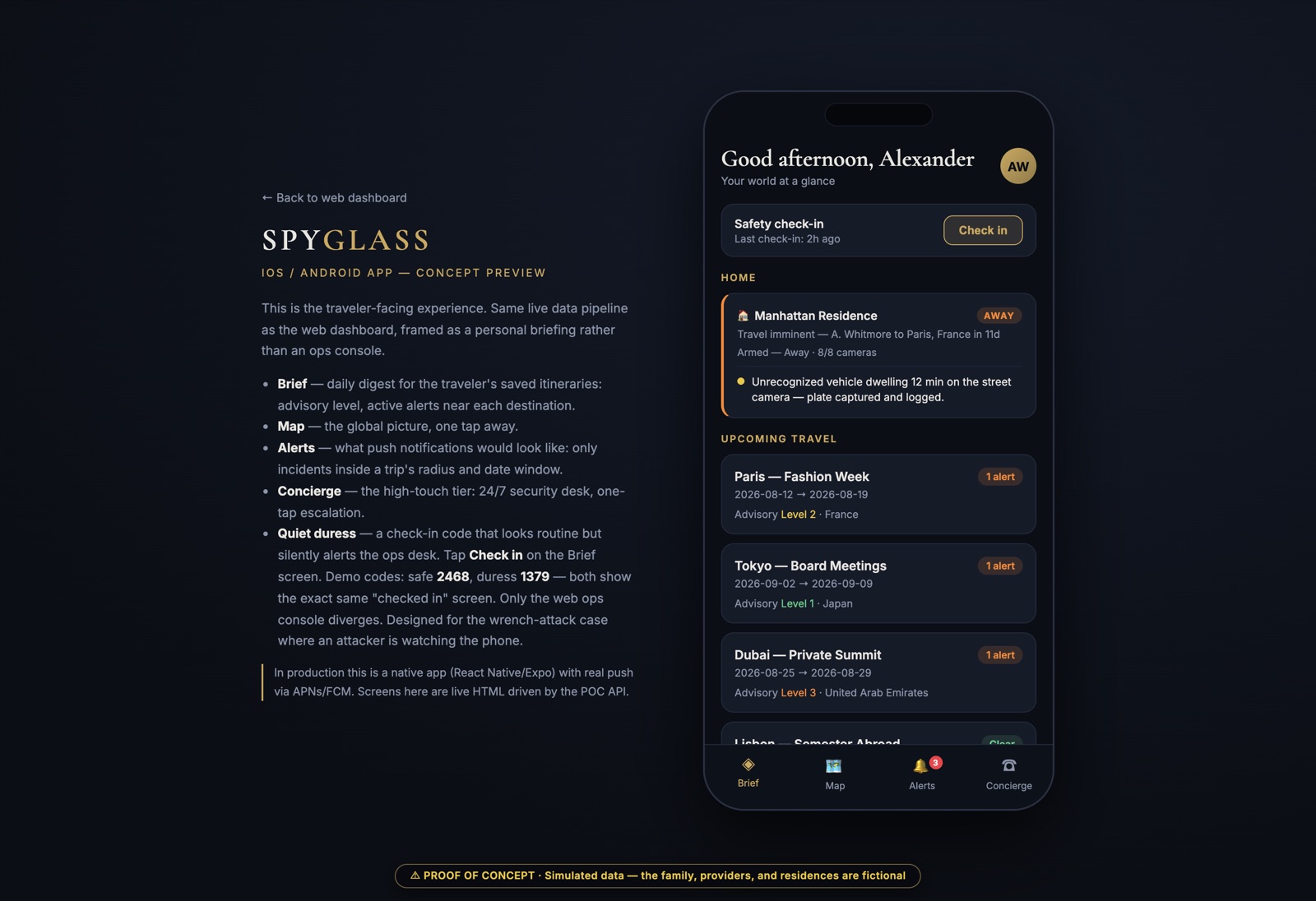
Spyglass is a working web-and-mobile concept that pulls live public incident data — global disasters, earthquakes, and government travel advisories — and matches it, in real time, to a family's travel itineraries. It layers on the capabilities this segment actually needs.
A family model where each member carries their own visibility rules, enforced server side rather than hidden in the interface.
A check-in that looks identical whether the traveler is safe or under threat, so nothing leaks to someone watching the screen.
An incident routes to the family's own providers along a stored playbook, honoring the confidentiality constraints those contracts carry.
Live public aircraft tracking data surfaces what the outside world can already see about a family's movements.
The duress check-in is the clearest example of security thinking driving product design. Safe and duress codes produce an identical screen on the traveler's phone. Only the operations console diverges, because the threat model assumes someone is watching.
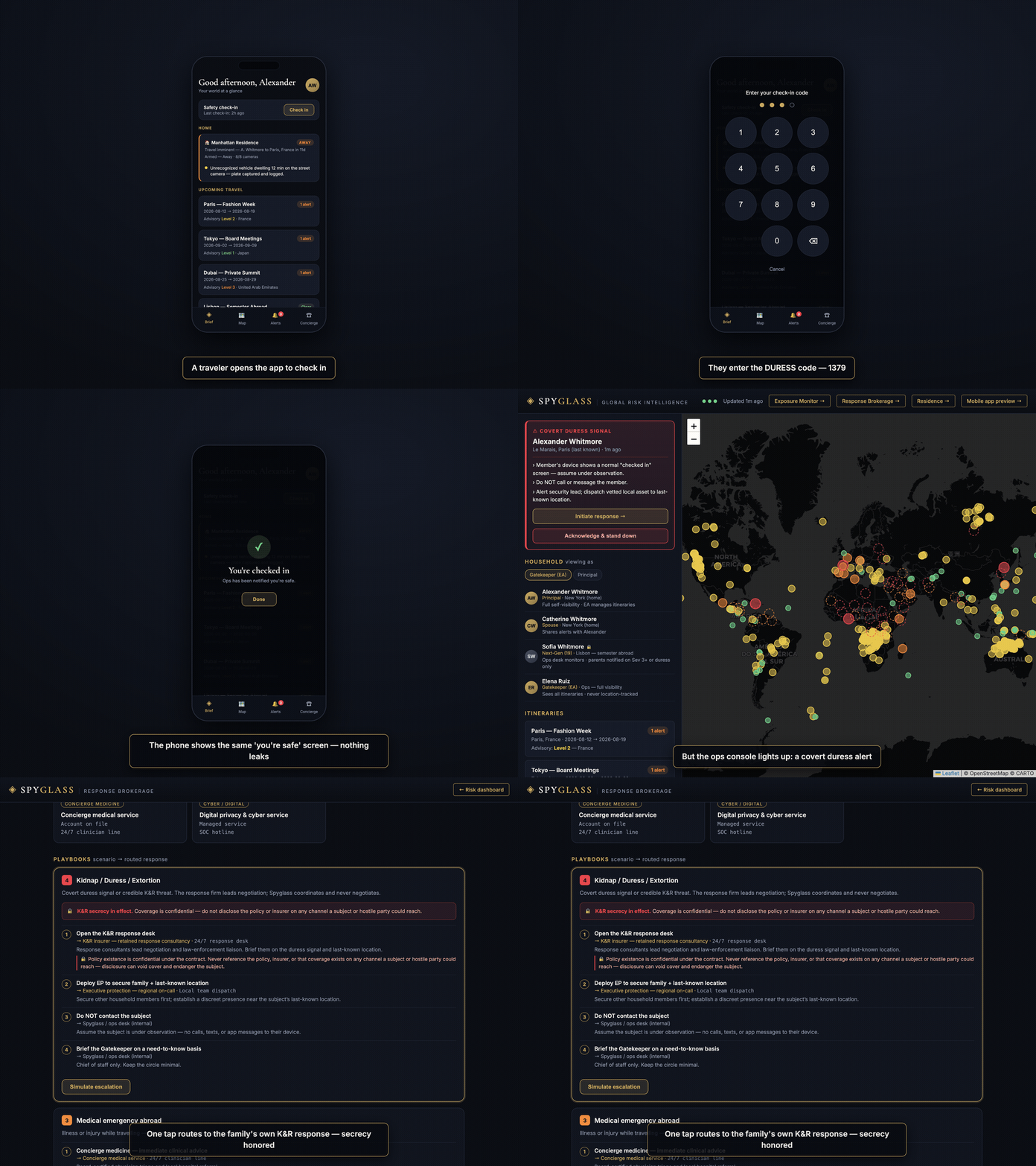
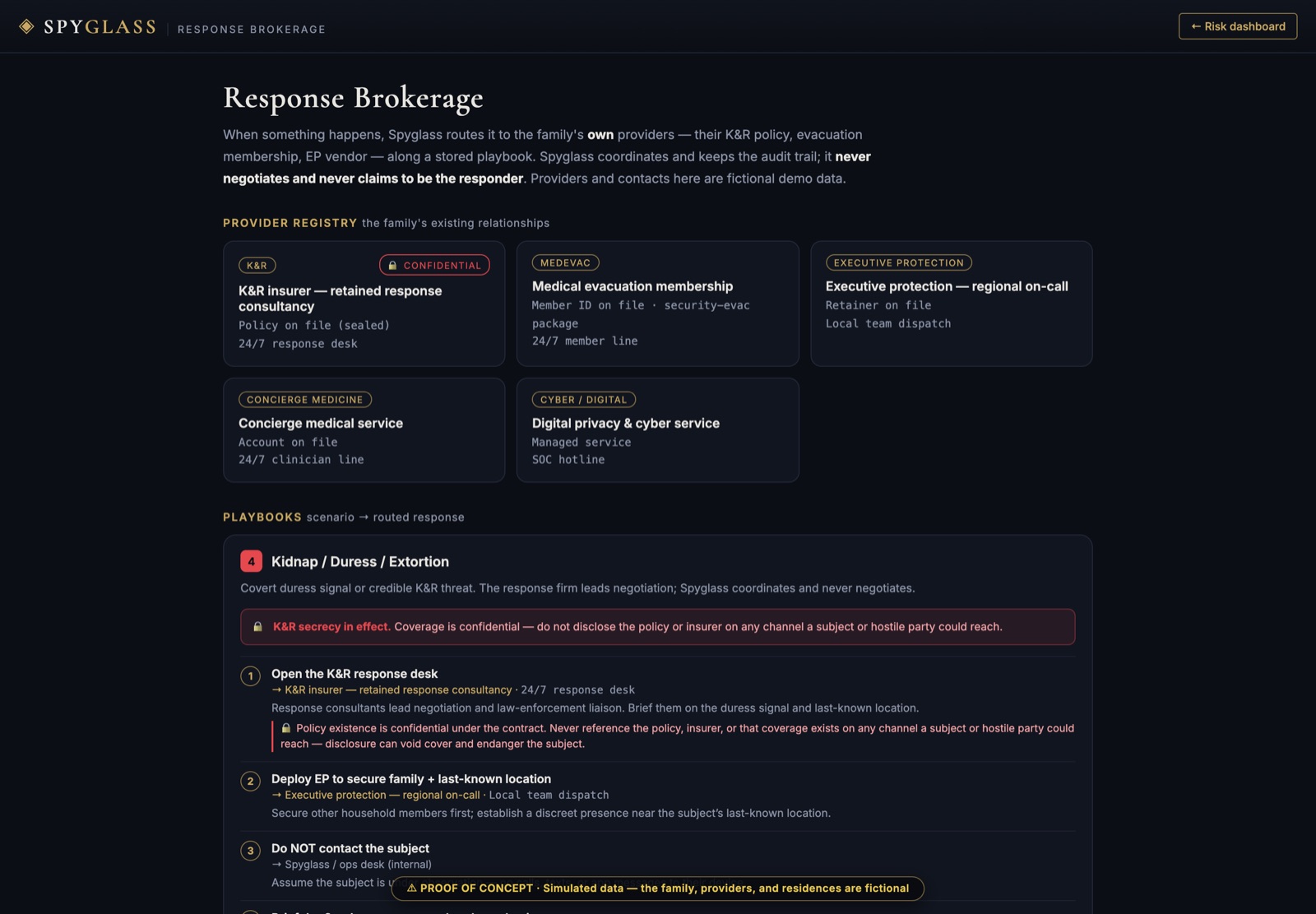
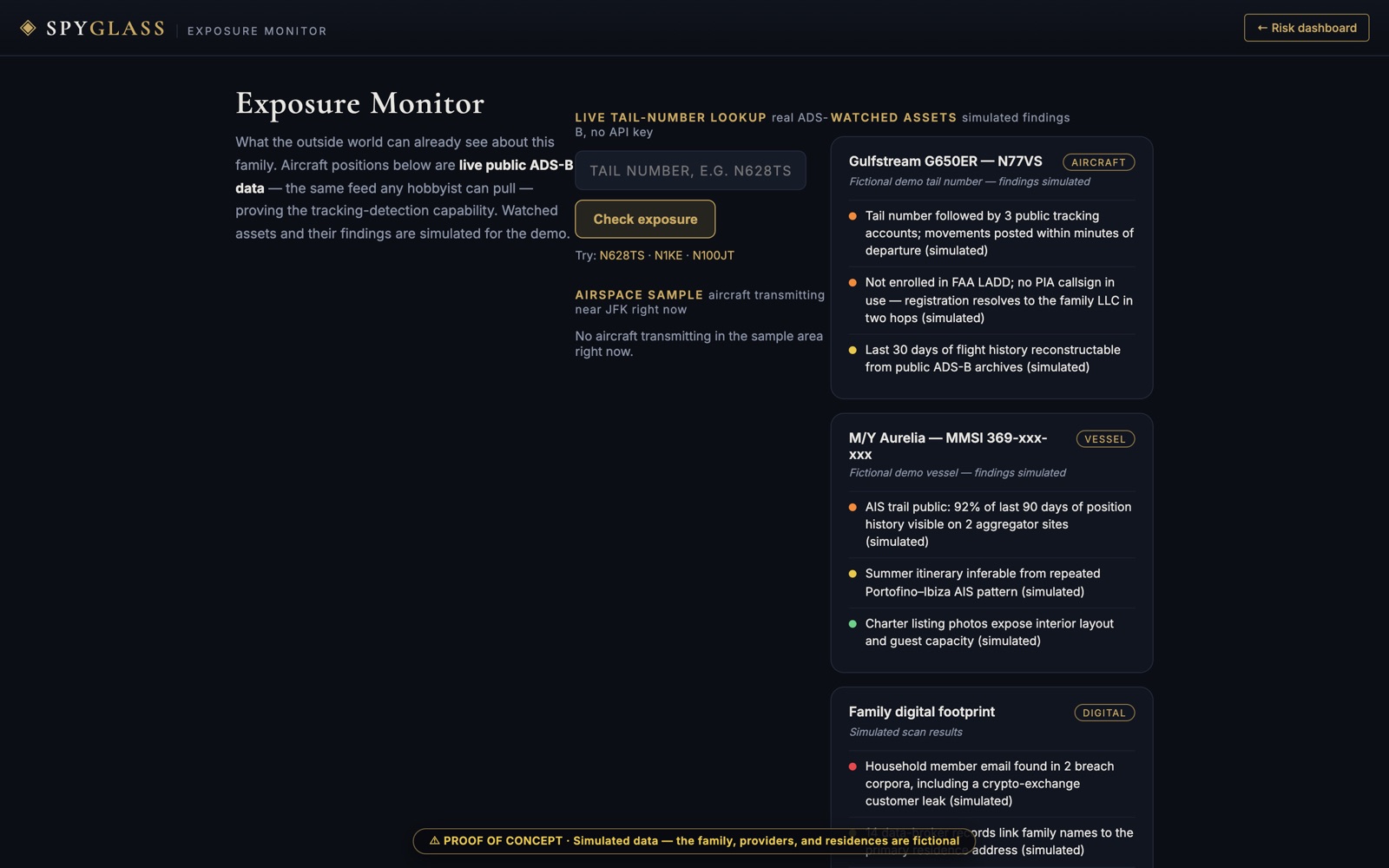
We ran it the way we run client work: research first, then a written product and technical specification, then implementation, with an automated test suite, continuous integration on every change, and disciplined version control throughout. The result is a documented, tested codebase, not a throwaway prototype.
Spyglass shows how we combine product engineering with a security-first mindset: privacy architecture, coercion-resistant design, and confidentiality handling treated as first-class requirements. It is the same discipline we bring to building and defending systems for our clients.
Built with Node.js, a live data-ingestion pipeline, public GeoRSS and GeoJSON feeds, a mapping front end, automated testing, and CI. Veteran-owned. Texas-built.
The same team, the same process: research, specification, tested software, delivered on time and on mission.